
,
Sunday, 18-October
ENHANCING THE PROFESSIONAL QUALIFICATIONS OF LANGUAGE TEACHERS AND WORKING WITH DIGITAL TOOLS
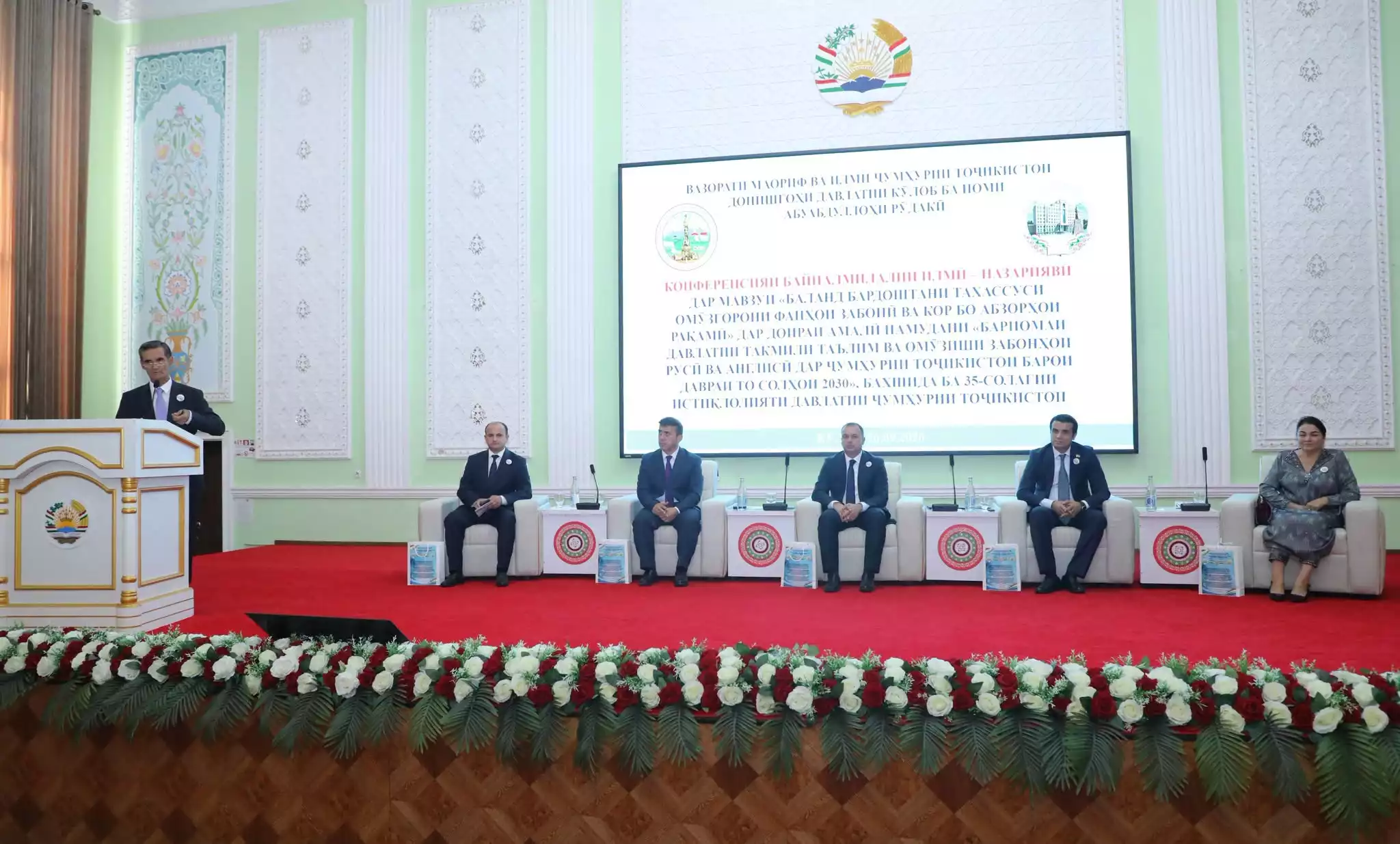
On 26 September 2026, Kulob State University named after Abuabdullohi Rudaki hosted the International Scientific and Theoretical Conference entitled “Enhancing the Professional Qualifications of Language Teachers and Working with Digital Tools.” The conference was organized within the framework of the State Program for the Improvement of Teaching and Learning Russian and English in the Republic of Tajikistan until 2030 and dedicated to the 35th Anniversary of the State Independence of the Republic of Tajikistan.
The conference brought together the University leadership, representatives of the Ministry of Education and Science of the Republic of Tajikistan, scholars and researchers, members of the academic and literary community, domestic and international guests, faculty members, staff, and students.
The presidium included Professor Safarzoda Munir Vatan, Rector of Kulob State University named after Abuabdullohi Rudaki; Associate Professor Kholiqzoda Ainiddin, Candidate of Philological Sciences and Head of the Department for Educational Quality of the Ministry of Education and Science; Professor Choriyev Tavakkal Ravshanovich of Bukhara State University (participating online); Professor Yusupova Zarina Rozikovna, Doctor of Philological Sciences from Bokhtar State University named after Nosiri Khusrav; and Associate Professor Murodzoda Bahriddin Rahmon of Kulob State University.
The conference commenced with an exhibition showcasing scientific publications, methodological materials, educational achievements, and resources related to the application of digital technologies in education. The official opening followed the performance of the National Anthem of the Republic of Tajikistan.
At the beginning of the event, participants watched a documentary video highlighting the statements and initiatives of the Founder of Peace and National Unity, Leader of the Nation, President of the Republic of Tajikistan, His Excellency Emomali Rahmon, concerning the preservation and development of the state language and the importance of learning foreign languages.
The conference was officially opened by Rector Professor Safarzoda Munir Vatan, who warmly welcomed all participants and guests.
In his address, the Rector emphasized that in the era of rapidly advancing technologies and the transition from traditional instruction to competency-based education, improving the qualifications of language teachers and effectively utilizing digital tools and artificial intelligence has become one of the most significant priorities of educational development.
He noted that the responsible and purposeful use of digital technologies contributes to improving educational quality, strengthening teachers professional competencies, and creating new learning opportunities.
The Rector also stressed that organizing the conference within the framework of the State Program and in celebration of the 35th anniversary of State Independence provides an excellent platform for exchanging scientific and pedagogical experience, developing educators digital competencies, and preparing specialists capable of meeting the demands of contemporary society.
According to the program, several keynote presentations were delivered during the plenary session.
Associate Professor Kholiqzoda Ainiddin, Candidate of Philological Sciences and Head of the Department for Educational Quality of the Ministry of Education and Science, presented a paper entitled “Implementation of the State Program for the Improvement of Teaching and Learning Russian and English in the Republic of Tajikistan until 2030.” His presentation focused on improving educational quality, monitoring the implementation of state educational programs, and applying modern teaching methods to develop language proficiency.
Professor Yusupova Zarina Rozikovna, Doctor of Philological Sciences from Bokhtar State University named after Nosiri Khusrav, delivered a presentation entitled “Problems of Authorship in the Era of Generative Technologies: A Philological Perspective.” She addressed issues related to generative technologies, copyright, academic ethics, and the responsible use of digital tools in scientific research and language education.
Participating virtually, Professor Choriyev Tavakkal Ravshanovich of Bukhara State University presented his paper entitled “Symbolic and Metaphorical Expressions Formed on the Basis of the Lexeme Zulf and Their Linguopoetic Features in the Idiostyle of Abdurahman Jami and Alisher Navoi.” His presentation explored artistic and linguistic analysis, the shared heritage of classical literature, and the role of expressive language in the works of these distinguished poets. His online participation further strengthened academic cooperation between higher education institutions of the two countries.
Associate Professor Murodzoda Bahriddin Rahmon, Candidate of Philological Sciences from Kulob State University, presented the paper “Improving the Professional Qualifications of Language Teachers, Especially Foreign Language Teachers, and Working with Digital Tools.” He introduced practical approaches to enhancing teachers professional skills and integrating digital technologies into language instruction.
One of the most significant parts of the conference was the discussion and question-and-answer session. Faculty members, researchers, and participants exchanged views on current issues in language teaching methodology, challenges associated with the use of digital technologies in education, and future prospects for language education.
During the discussions, Associate Professor Kholiqov of Kulob State University also shared his perspectives on the effective application of modern digital technologies in the teaching process.
Participants engaged actively with the speakers, discussing ways to improve teachers professional development, enhance the effective use of digital tools, and explore the potential of artificial intelligence in language education.
At the conclusion of the plenary session, it was emphasized that the scientific and methodological recommendations developed during the conference could serve as a valuable foundation for improving contemporary teaching approaches, designing innovative methodologies, enriching language education curricula, and advancing the digital educational environment in secondary and higher education institutions.
In the afternoon, the conference continued its work in three specialized sections, during which 129 scientific papers submitted by scholars and specialists were presented and discussed.