
,
Wednesday, 21-October
THE ROLE OF BOTANICAL INSTITUTIONS IN THE CONSERVATION OF BIODIVERSITY
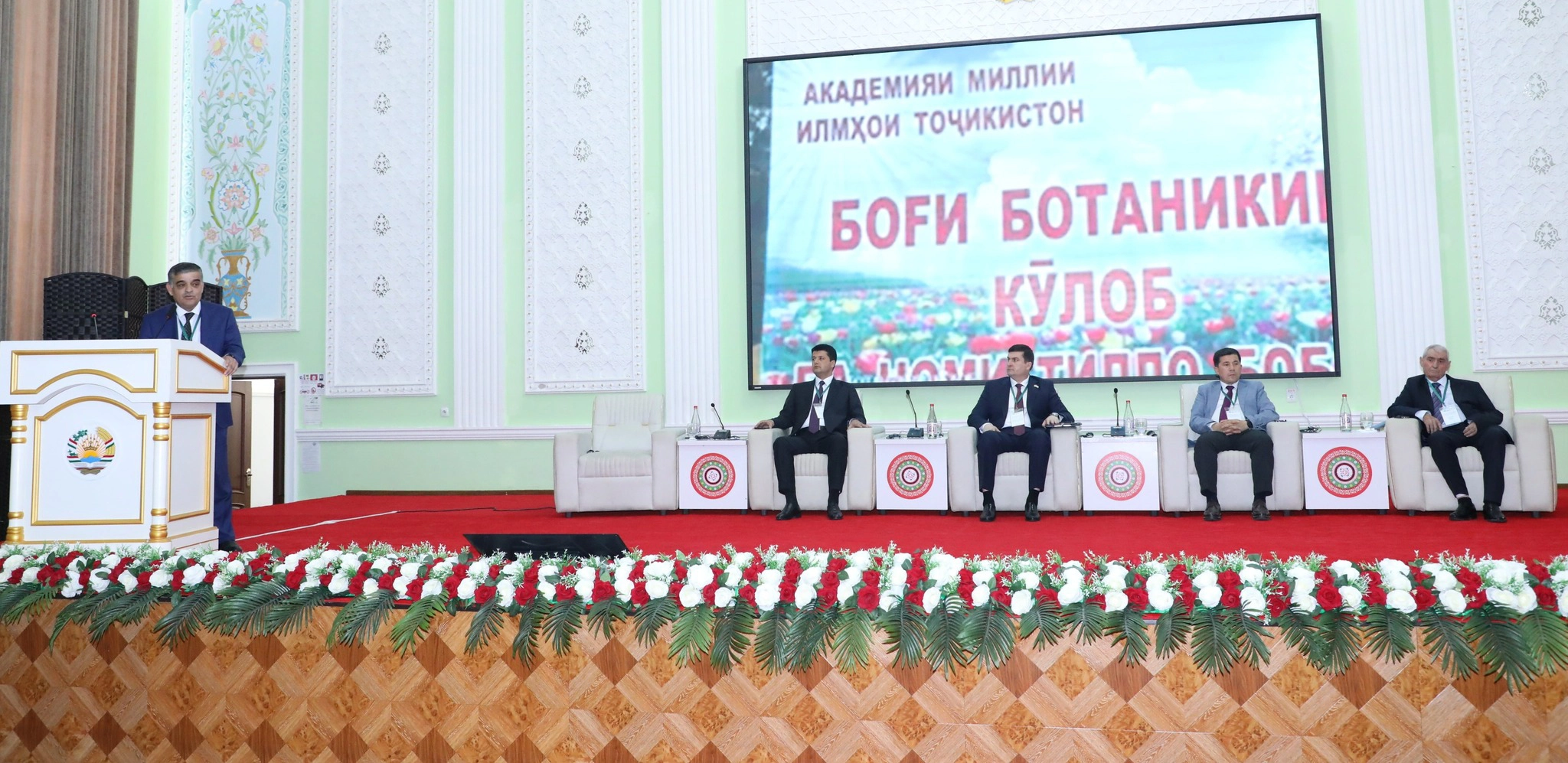
Today, May 6, Kulob State University named after Abuabdulloh Rudaki hosted an international conference titled “The Role of Botanical Institutions in the Conservation of Biodiversity.” The conference was organized by the Khatlon Scientific Center of the National Academy of Sciences of Tajikistan and dedicated to the 35th anniversary of the State Independence of the Republic of Tajikistan, the 75th anniversary of the National Academy of Sciences of Tajikistan, and the 40th anniversary of the Kulob Botanical Garden named after Tillo Boboev.
The conference was attended by the President of the National Academy of Sciences of Tajikistan, Academician Khushvakhtzoda Qobiljon Khushvakht, Vice-Rector for Academic Affairs of Kulob State University named after Abuabdulloh Rudaki, Associate Professor Abdusamad zoda Eraj, a representative of the executive authority of the city of Kulob, as well as scientists and researchers from within the country and abroad.
At the beginning of the event, the Vice-Rector for Academic Affairs, Associate Professor Abdusamad zoda Eraj, delivered an opening speech, warmly welcoming the guests and participants. He emphasized that holding such scientific forums plays an important role in strengthening scientific cooperation, exchanging experience, and further developing research in the field of natural sciences. In his opening speech, the President of the National Academy of Sciences of Tajikistan, Academician Khushvakhtzoda Qobiljon Khushvakht, noted that in the context of climate change and the increasing impact of anthropogenic factors, the conservation and rational use of natural resources, including biodiversity, has become one of the key issues of modern science. It was emphasized that botanical institutions, as important scientific-theoretical and practical centers, play a significant role in the study, conservation, restoration, and enrichment of plant diversity.
It was noted that botanical gardens serve not only as scientific bases but also as educational and awareness centers for enhancing public knowledge and environmental awareness. In this regard, strengthening international cooperation, implementing modern technologies, and involving young specialists in scientific activities are considered priority areas.
It was stated that the state policy of the Republic of Tajikistan, under the leadership of the Founder of Peace and National Unity — Leader of the Nation, President of the Republic of Tajikistan, Honourable Emomali Rahmon, pays special attention to environmental protection and the sustainable use of natural resources, creating favorable conditions for the development of natural sciences and the expansion of scientific institutions.
Subsequently, Corresponding Member of the Academy of Sciences of the Republic of Tajikistan Saidov Abdusattor and other scientists and researchers, in their speeches, paid special attention to key issues in the development of botanical sciences and biodiversity conservation. It was noted that in-depth study of floristic resources, identification of rare and endangered species, as well as the development of effective mechanisms for their protection, are among the primary tasks of scientific institutions.
At the same time, participants emphasized that in the context of globalization and rapid climate change, the need to strengthen research activities, introduce innovative methods, and use modern technologies in environmental protection is steadily increasing. In this regard, the expansion of scientific cooperation with leading international centers and the implementation of joint programs for ecosystem conservation were recognized as important.